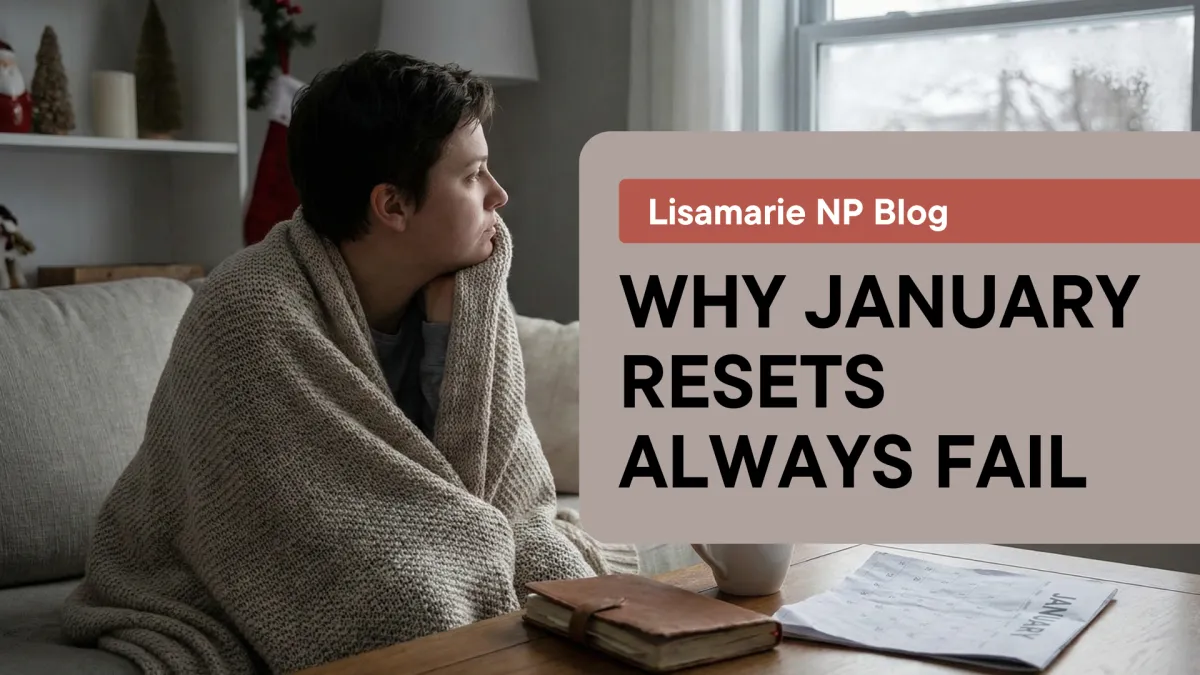
Why January Resets Fail — And What Your Body Is Actually Responding To
January comes with a lot of pressure.
There’s an unspoken belief that this is the moment things should finally work.
New year. Fresh start. Clean slate.
So when the reset doesn’t stick, it doesn’t just feel disappointing — it feels personal.
But here’s the truth most people never hear:
January failures are rarely about willpower. They’re about physiology.
Your body doesn’t recognize the calendar.
It doesn’t know it’s a new year.
What it responds to is stress, consistency, safety, and input.
And by the time January arrives, most bodies are already compensating.

December disrupts sleep.
Schedules shift.
Emotional load increases.
Even “good” stress adds up.
So when January brings restriction, pressure, and sudden rules, the body doesn’t interpret that as a reset.
It interprets it as instability.
Under pressure, the nervous system shifts into protection.
Digestion slows.
Blood sugar becomes more volatile.
Hormones adapt to conserve resources.
That’s not dysfunction.
That’s survival.
This is why aggressive resets so often backfire.
They interrupt compensation without creating safety.
Real change doesn’t come from forcing the body to behave.
It comes from creating conditions where the body no longer needs to compensate.
That’s the difference between compensation and healing.
Compensation is how the body survives stress.
Healing is what happens when stress is reduced enough for the system to recalibrate.

Healing looks quieter.
Slower.
Less dramatic.
But it holds — because it’s aligned with how systems actually work.
January doesn’t need punishment.
It needs stability.
And when stability is present, the body does what it’s been trying to do all along — restore balance.
This is the lens I use in my work, because it’s the only one that holds up under real life.